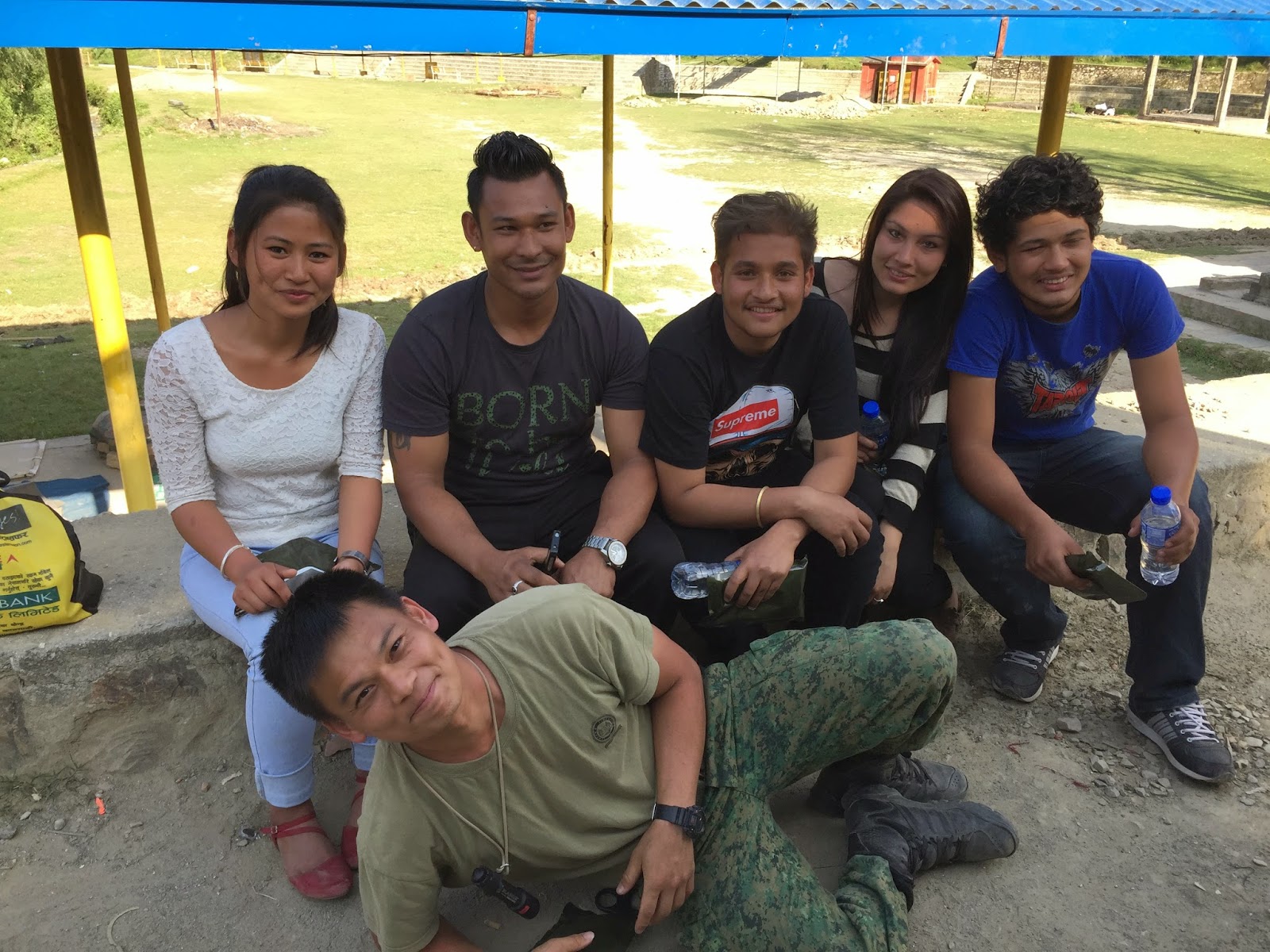
In 2012, I was actively blogging about my Nepal trip. With the hum drum of daily work and responsibilities, it came to a halt. Now, this earthquake has jolted back the part of me that was hibernating. I am back to blog... with the hope that some learning points can be shared.....
Back then, I knew that I would return to Nepal and continue our work. But with the responsibilities of work, passing examinations and family, we were struggling to find this time. Little did I expect the calling would come in the form of a natural disaster.
Hence when the opportunity arrived for me to help as a doctor with the earthquake relief efforts, my heart skipped a beat.
Ever since we had heard the news of the earthquake on 25th April, we were restless. Our eyes were glued to the news and the internet, checking for updates. 2 days into the earthquake, I heaved a sigh of relief when our Nepalese friends were marked safe on facebook. The joy of the internet!!!
I went as part of the Singapore team, consisting of MOH, SAF and the Brunei army. On the MOH team, there were 3 doctors, one of whom is of Nepalese origin and 4 nurses. During the same period, Kumaran went with the Mercy Relief team.
We had heard so much from the media and everyone was telling us to 'Be safe' that I got slightly apprehensive. An array of thoughts were running through my head- mainly what will be the sight that will greet us? Having remembered Nepal for what it was 3 years ago, I felt unprepared to face a sight of despair and gloom. Why must such misfortune strike a country that is already deprived? How will they cope with such a blow?
With such thoughts, I left Singapore for Nepal on 1st May 2015.
Finally in Nepal
 |
| A sense of familiarity upon spotting Everest from the C-130 |
 |
| Transit at Calcutta- with the Airforce and ground staff |
After transiting in Calcutta for a day, we arrived at KTM airport on the SAF C-130 and were brought to our living area which was the former airport bomb disposal site. The site was now transformed to an area for the International Search and Rescue as well as Humanitarian aid teams. While the airport was packed with planes bringing in relief aids, the campsite was full of teams from all over the world. The constant stream of planes meant that we had to circle in mid air for about 1+ hours while awaiting a 'parking lot'.
 |
| Our living area- the bomb disposal site which is next to the aiport runway |
 |
| The 'Kitchen' at our campsite. In such disaster relief operations, it is crucial to be self sufficient. Our role is to help the host country and not expect the host country to be able to support us. |
 |
| Our team |
When we arrived in the city itself, what I saw was contrary to what I had expected. Things were functional... most shops were open. And people had even started about their activities of daily living. I thought to myself, 'Wait a minute. Did an earthquake just happened?'
The people appeared as cheerful as they were when I last saw them in 2012. The children were playing... the ladies were washing their cloths in the public pipes and the farmers were ploughing the field. It was week 2 after the earthquake.
 |
| The villagers were conducting prayers where they would carry the God around the village |
 |
| Offerings that are made to the Gods- the chicken |
 |
| The children that hung out at our clinic. Schools are still closed. It was fortunate that the earthquake occured on a Saturday afternoon, which meant that most people were outside buildings and houses. |
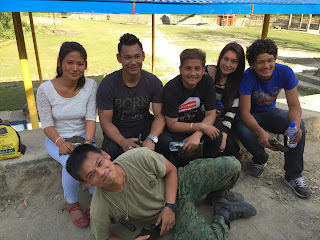 |
| The translators who travelled by bus to Gorkana every day |
 |
| The children washing up |
 |
| Even a wedding was taking place at the temple!!!! |
But what one sees on the surface is not a true reflection of the actual situation. Help arrived in Kathmandu first and hence there were many tent cities set up in open fields. But the city dwellers still lacked many basic necessities as it was trapped within their collapsed houses. The situation was more dire in the outskirts of the city, where the roads have become inaccessible. Hence aid hadn't arrived to these villagers. Despite all these shortcomings, they picked themselves up and continued on with their lives. This left me awestruck.
 |
| A tent in the middle of a schoolyard. A few families live within the tent |
 |
| Aid hasn't arrived. Hence they have created a flimsy tent in the middle of a field. It probably wound't survive the strong monsoon winds |
Our work
Everyday, we would set off on a bus to Gorkana, where we had our clinic base. From there one mobile clinic team would set off with the medical supplies into a village hit by the quake. In the village, a few tables and chairs and a translator would be our clinic.
Gagalphedi, Gamcha, Baluwar and Jeewanpur were some of the villages that we had visited.
We saw a variety of patients, most of whom had primary care problems, such as gastritis, backaches and URTI. The life threatening and major trauma cases were mostly treated in the hospitals by the time we arrived. However there was still a number of infected wounds and untreated fractures from the earthquake.
 |
| A boy walked in with this on his wrist, saying that he had injured his wrist when he fell on it while running during the earthquake. Instead of plaster of paris, he was using cardboard to splint his wrist. |
 |
| People being triaged |
 |
| The resuscitation area- where we saw a few breathless patients and did procedural sedation for minor procedures |
 |
| Irrigating a wound sustained from the earthquake |
 |
| Mobile clinic- we learn to make use of the space and materials we can find to put together a 'clinic' |
 |
| Performing wound debridement, with the nurse holding the torchlight |
For many, the stories behind each patient was a heavier load than the medical conditions they had. I realised that each and every one of them have been directly or indirectly hit by the quake.
Many of them were left homeless, either because their houses had collapsed or was too unsafe to be inhabited. Hence they were living in either tents given to them or had made their shelter from pieces of scrap materials.
They were sleeping with just a sheet between their bodies and the ground. It gets very cold at night. Hence the backaches and respiratory tract infections they presented with.
Food and water was limited. Hence the gastric pains and dehydration they experienced.
The hospital was too far away or too crowded. Hence the upper limb fractures were treated conservatively with a sling.
The acute medical phase was over and the rehabilitation phase had started. The problems that each patient carried to our clinic was more than what my medical box or stethoscope could provide.
The media was right after all- the devastation was fast and much help is needed.... but where and how?
Time to leave
The 10 days spent in Nepal was an eye- opening experience to how International relief aid groups function. We were part of a government to government international aid while Kumaran was part of NGO aid group.
It was heartwarming to see the rest of the world helping Nepal in one way or another. But one cannot help but wonder if things could be done better.... in a more coordinated and efficient manner.
The thing that amazed me most, was the resilience of the Nepalese people. Many locals said they were lucky to be alive. Their positivity amidst such a disaster was remarkable. It probably has to do with their faith.. I got reminded of the Gods that reside in the mountains that loom over Kathmandu Valley... watching over their people.
However, as I left Nepal, that unsettling feeling returned again. Could we have done more? How will these people survive the monsoons that are about to arrive? Where is the government? So much of help is arriving yet the people are still in need of basic necessities.
I returned home with a heavy heart......
26th May 2015
It is nearly 2 weeks since we returned from Nepal and much has happened since.
Coincidentally, Kumaran and I returned on the same day.. following which a second earthquake hit Nepal.
Our hearts got heavier and our thoughts pondered over Nepal.
But at that point, there were some ideas brewing within us about how we could help. What if we could bypass the government and red tapes and help a village directly?
We found a way!!! While in KTM, Kumaran had met Mr Netra Mani, the ex-headmaster of Saraswoti school. In 2012,Mr Netra Mani had helped us to purchase the computers in KTM for the school. We then travelled with him to the school. He was our reliable connection to the school as well as the village from which the students came from- called Katteldada.
Though Katteldada is within Gorkha, it is so small, that it remains forgotten. With the earthquake, the children have been left homeless. In such a state, school has become a secondary concern. The school and the children have come a long way. It will be a pity for the years of hard work to go to waste. As we spoke of the situation, we realised that together with Netra Mani, we may be able to rebuild the village.
Emails flew by and Netra Sir was confident of purchasing the zinc sheets which the villages can use to form a temporary shelter to take them through the monsoon while their houses get rebuilt.
Hence the birth of our fund-raising '
Rebuild a Village'.